|
This type of dating can only be used on igneous rocks, such as granite or rocks that form from lava
flows (basalt, for example). It cannot normally be used for sedimentary rocks (where fossils are
typically found) like limestone and sandstone.
Radiometric dating in general depends on three major assumptions:
-
When the rock forms (hardens) there should only be 'parent' radioactive atoms in the rock and no
'daughter' atoms (derived by radioactive decay of the 'parent' element)
-
After hardening, the rock must remain a closed system, that is, no parent or daughter atoms
should be added to or removed from the rock by external influences such as percolating
groundwater
-
The radioactive decay rate must remain constant.
If any of these assumptions are violated, then the technique fails and any ‘dates’ are false. The
sweeping nature of these assumptions, and the contradictory dates that are sometimes generated
(see examples below), illustrate that the approach is not scientific.
Huge discrepancies are found with dates indicated by radiometric dating and carbon dating. The
following article describes the remains of a tree dated at circa 40,000 years, which was engulfed by a
basalt lava flow more than 40 million years ago: Radioactive dating in conflict
Another example is the dating of lava flows that are known to have occurred within the last century -
radiometric dating has indicated that the rocks are up to 3.5 million years old: Radioactive dating
failure
A creationist group "Radioisotopes and the Age of The Earth" (RATE) researched the age of zircon
crystals in granite. Using one set of assumptions based on uranium decaying to lead and helium,
these crystals could be estimated at 1.5 billion years old. However, if the assumptions are tested,
the date doesn't make sense. Measurements of the rate that the helium leaks out of the crystals
indicates that if they were older than about 6,000 years they wouldn't have the amount of helium
measured in them. Therefore the dating method is flawed, meaning that the crystals may even be
younger than 6,000 years.
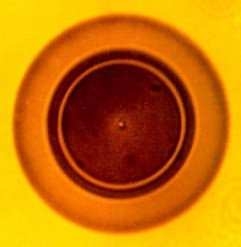
Planetary evolution states that the Earth was originally a hot molten mass. Granite contains
polonium halos (see right), the presence of which indicate that granite was never a hot molten mass.
There is no scientific explanation for how granite was formed, if granite is melted and allowed to cool
down it doesn't form back into granite. Physicist Robert Gentry has reported isolated radio halos of
polonuim-214 in crystalline granite. The half-life of this element is 0.000164 seconds. To record the
existence of this element in such a short time span, the granite must have formed the crystalline
state instantaneously. This runs counter to evolutionary estimates of 300 million years for granite to
form. Polonium halos would not be present if it took this long.
|

 Previous
Next
Previous
Next