|
Home
>
Consider the evidence
>
Anthropology
>
The Missing Link
|
 Previous
Next
Previous
Next 
|
|
|
|
|
|
|
The "missing link", which is a transitional form between ape and man, is still
missing ...
All fossils found so far that were originally thought to be the "missing link" have
been re-classified as either human or ape. Neanderthals and Cro-magnon were
humans. Ramapithecus, gigantopithecus and zinjanthropus were just apes.
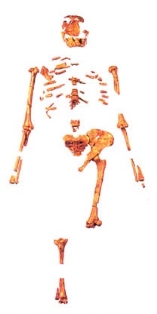
One of the most famous "human" fossils was called Lucy (see left). This was
the name given to the much promoted fossilised skeleton that was discovered
during 1974 in Ethiopia by anthropologist Donald Johanson.
Lucy has served as the poster child for Darwinism ever since yet
Anthropologists proved in 1987 that Lucy was just an ape, in fact, a male ape!
Lucy is still claimed as a missing link in some textbooks around the world. The
fossilised remains of Lucy (Australia Pithecus) are about 40% of the skeleton
of a small ape. The hands and feet were more curved than a chimps and the
ape would not have walked upright.
|
|
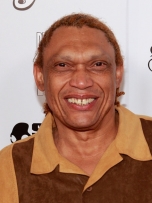
The modern diversity of mankind is amazing, take the human skull as an example. The
picture to the right is of actor Hawthorne James, who played the bus driver "Sam" in the 1994
film Speed. He is over six feet tall, he has a very pronounced brow, and his skull is much
larger than a shorter persons would tend to be. Similarly, the picture far right is of Clancy
Brown, playing the character "Kurgan" from the 1986 film Highlander.
It is easy to see how false conclusions could be drawn from recovering a skull like this
compared to a smaller skull without such a large brow. Other examples of varying skull
shapes may be the result of bone-altering diseases such as rickets or Paget's disease.
Where certain characteristics are prominent, it would not be surprising to find these shared
within certain closed people groups. As indicated by fossil evidence, this seems to be the
explanation for the Neanderthals, a distinct people group that died out long ago who shared a
pronounced brow. |
|
|
|
|